
Node topology
Validator, API, client, and explorer roles are separated according to availability, access, and trust requirements.
- Validator placement and membership
- Private inter-node connectivity
- Public or restricted API and explorer roles
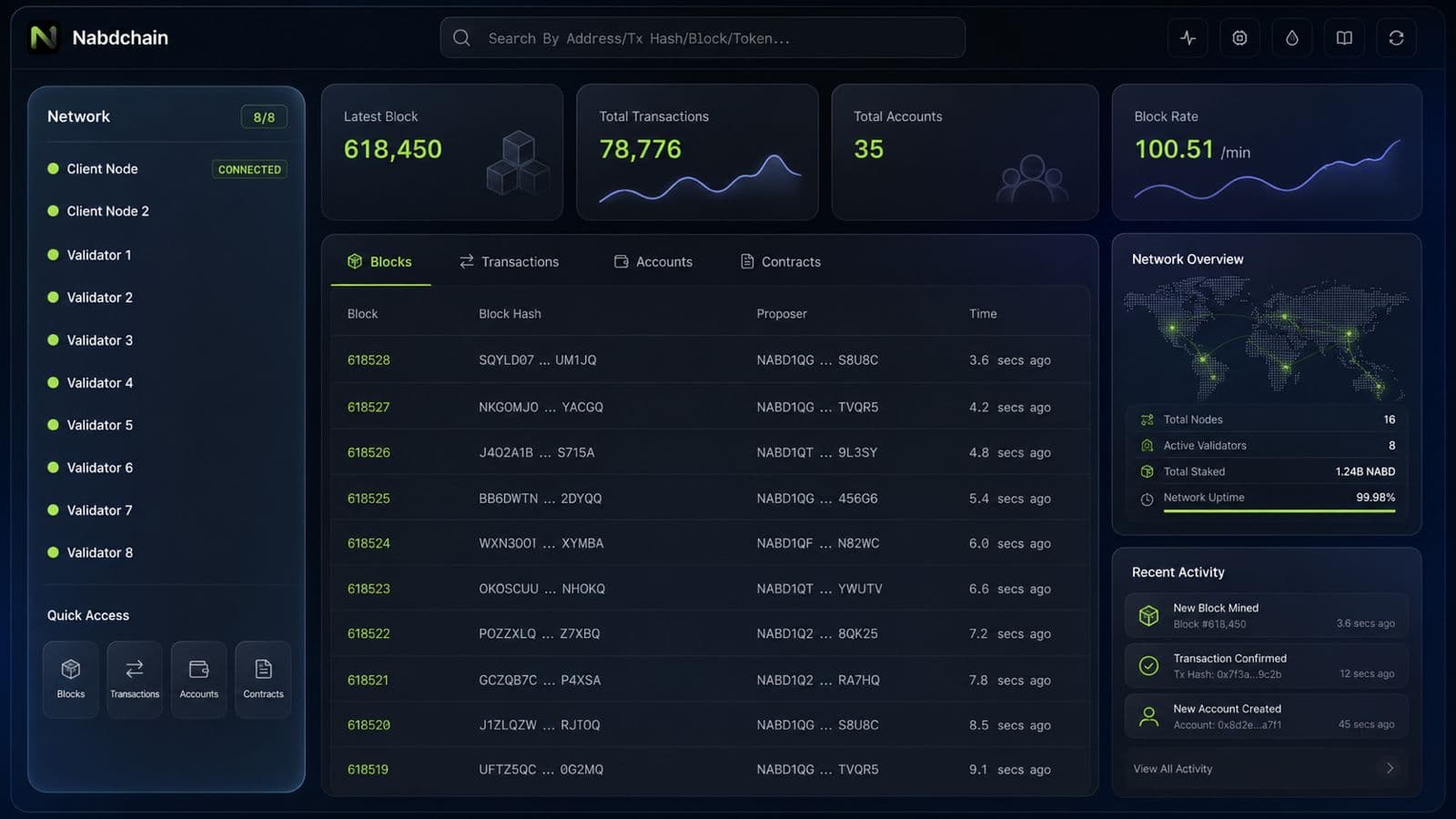
Validator, API, explorer, governance, and operating infrastructure for a dedicated NABD network.
A blockchain deployment is more than a group of validator processes. Node roles, trust assumptions, network access, transaction APIs, governance, and recovery all need an explicit owner.
ATL defines those layers together and exposes network state through monitoring and explorer services.
Validator, API, client, and explorer roles are separated according to availability, access, and trust requirements.
Governance and administration define who can operate nodes, change membership, and approve network-level changes.
Wallets, POS systems, and applications connect through controlled transaction and query interfaces.
Monitoring, backup, recovery, and change procedures are prepared for the node roles in the target environment.
ATL can scope this area as a focused component, an integration, or part of a complete engineering program.
Contact ATL